Trump, Xi and Cold War 2.0: Managing Rivalry in a Fragmented World
Source: Moderndiplomacy.euPosted by RAJNEET Editorial • about 6 hours ago
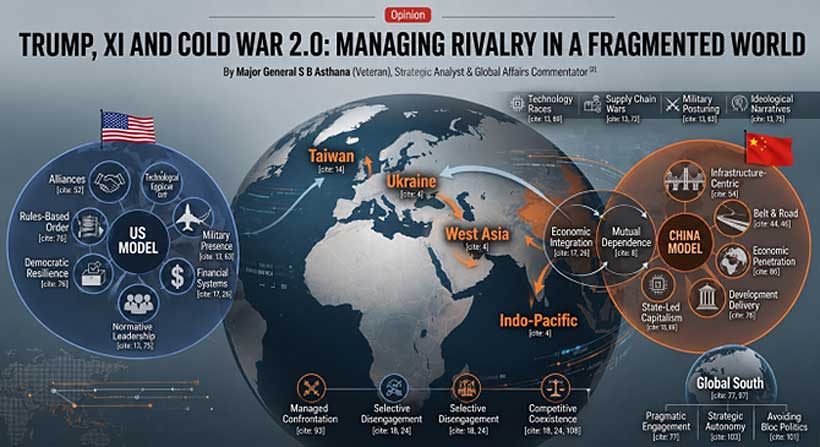
Trump, Xi and Cold War 2.0: Managing Rivalry in a Fragmented World
The world witnessed a historic shift in global politics when US President Donald Trump and Chinese President Xi Jinping engaged in a high-stakes diplomatic standoff in 2018. The two leaders, who had previously enjoyed a fragile rapport, found themselves on opposite sides of a contentious trade war that threatened to upend the global economy. The tension reached a boiling point in mid-November 2018, when Trump announced the imposition of tariffs on $200 billion worth of Chinese goods, prompting Xi to retaliate with a tariff hike on $60 billion worth of US products. The conflict sparked widespread concern among economists and policymakers, who feared that a full-blown trade war could have far-reaching consequences for global economic stability. As the standoff continued, the international community watched with bated breath, wondering if a new era of Cold War-era rivalries was unfolding in the 21st century.
The roots of the US-China rivalry date back to the early 2000s, when China's rapid economic rise began to challenge the United States' long-standing status as the world's sole superpower. As China's economic influence expanded, Washington grew increasingly wary of Beijing's intentions, particularly in terms of its military modernization, Belt and Road Initiative (BRI), and human rights record. The Trump administration's decision to impose tariffs on Chinese goods was seen as a response to China's alleged unfair trade practices, including intellectual property theft and state-sponsored subsidies. However, many experts argue that the trade war was also a symptom of a deeper, more complex struggle for global influence.
For Indian citizens, the US-China rivalry has significant implications, as it threatens to disrupt the global economy and destabilize the delicate balance of power in the Indo-Pacific region. The trade war has already led to higher prices for consumers, particularly those in the electronics and manufacturing sectors, while also raising concerns about the long-term sustainability of global supply chains. As the US-China rivalry intensifies, India's policymakers are likely to face increased pressure to navigate the treacherous waters of great power politics, all while maintaining the country's economic and strategic interests. Experts have warned that a prolonged trade war could have far-reaching consequences for India's economic growth and stability, particularly if it leads to a decline in global trade and investment.
As the world grapples with the implications of a US-China rivalry, one question remains: can India find a middle path between
Public Debate
Live Public Opinion
Select your stance to enter the debate:
Join the Conversation
Follow us on Instagram for daily updates
@rajneet.co.in